How to Set Grow Light Distance and Coverage
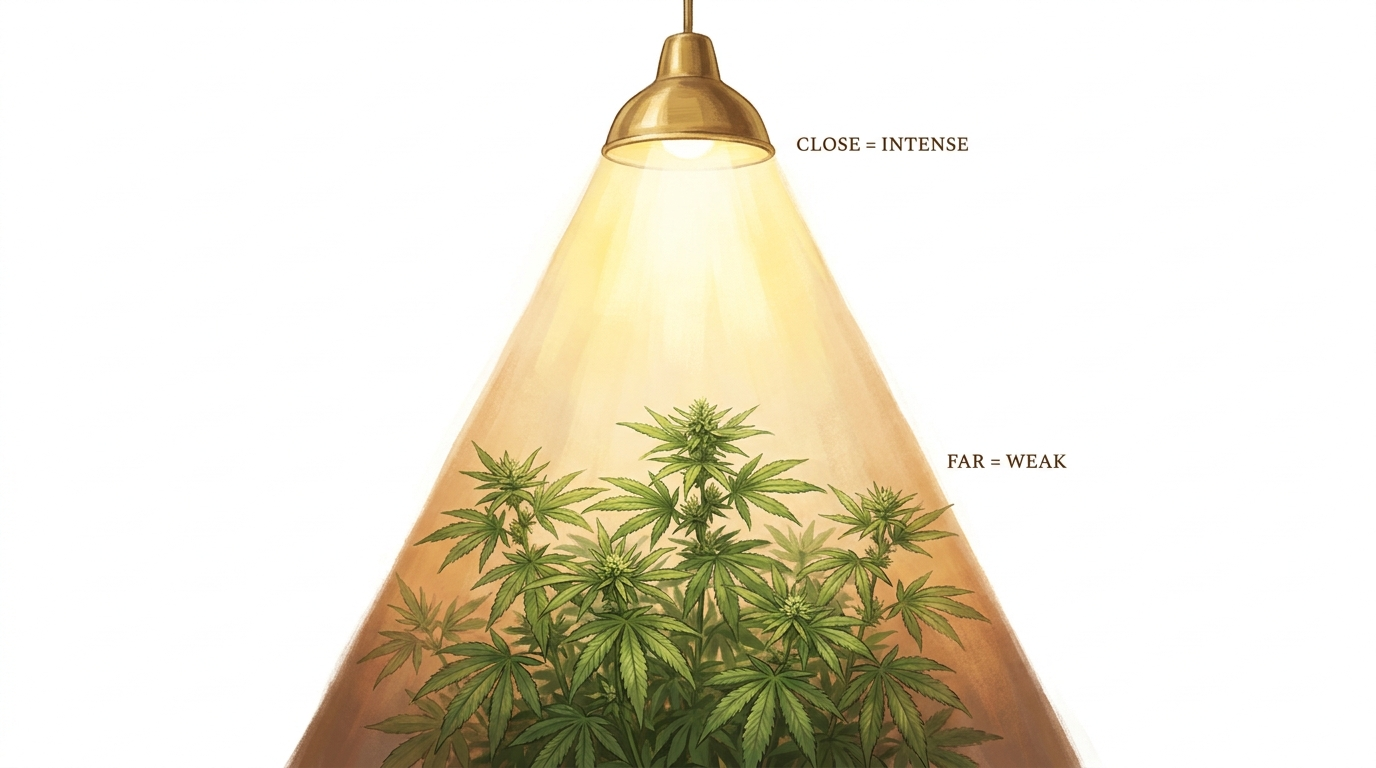
Light distance is where good lights get wasted. The same fixture can starve or scorch a plant depending purely on how high it hangs — and the rule that governs it, the inverse square law, is the most practically useful physics in all of growing. Here’s how to find the right height and read when you’re wrong.
The short version:
- Double the distance and intensity drops to a quarter — not half
- Too close: centre hotspot, bleached top leaves; too far: even but weak, airy buds
- Starting band for most LEDs in flower: 30–45cm above the canopy
- Match the light to the tent — a small light can’t cover a big footprint, full stop
- Measure with a PAR app at the centre and corners, then adjust
Want the full breakdown? Keep scrolling.
What’s the inverse square law (and why it matters)?
It’s simple and brutal: double the distance between light and canopy, and intensity falls to one quarter. At 60cm you get 25% of what you’d get at 30cm; at 90cm, about 11%. So every centimetre you raise the light costs you real intensity. I made both mistakes at once — hung a weak light at 30cm (intense centre, dark edges), then raised it to 60cm on forum advice and got even-but-useless light everywhere. The Skyscraper grower hangs the LED at the very top for “maximum coverage” and gets 200–300 PPFD across the canopy — fine for veg, starvation in flower — then is baffled because the box said 800 at 30cm. It said at 30cm. Physics doesn’t care about intentions.
How do I find the right height?
Find the height where your light delivers the right PPFD at canopy level — not so close it bleaches, not so far it’s weak. For most LEDs, 30–45cm above the canopy in flower is the starting band (an 80x80cm tent with a 200W or a 120x120cm with a 300–320W both land there), but it’s a starting point, not a rule. Confirm it: a PAR app like Photone on your phone (or a dedicated meter for precision) reads your actual canopy — take the centre and each corner. Centre 800 and corners 200 means it’s too close; centre 400 and corners 350 means good height but maybe a weak fixture. Use ratchet hangers (DIG stock them) so you can raise the light easily as the plant grows.
How do I read bleaching and coverage?
If the leaves closest to the light bleach — pale white tips, curling away — the PPFD there exceeds what the plant can process; raise the light 10–15cm and check the next day. If only the very top leaves are affected and the rest look healthy, you were just a touch too close. The other lesson is coverage: a 100W LED in a 120x120cm tent doesn’t reach the corners, full stop — the inverse square law guarantees the edges get a fraction of the centre, so corner plants come out smaller and stretchier. If you can’t afford a light that covers the whole space, use a smaller tent. Matching light to space beats matching light to budget every time.
FAQ
How far should my grow light be from the plants? Most LEDs sit around 30–45cm above the canopy in flower, but it depends on the fixture’s strength. Measure PPFD at the canopy if you can, and watch for bleaching (too close) or stretch (too far).
Why are my top leaves bleaching? The light is too close — the intensity at those leaves exceeds what they can use. Raise it 10–15cm and recheck in a day; new growth should come in normal.
My corners grow worse than the centre — why? The light doesn’t cover the footprint. Intensity falls off sharply toward the edges, so an undersized light leaves the corners starved. Use a bigger light or a smaller tent.