Low Stress Training (LST) for Cannabis: A Beginner's Guide
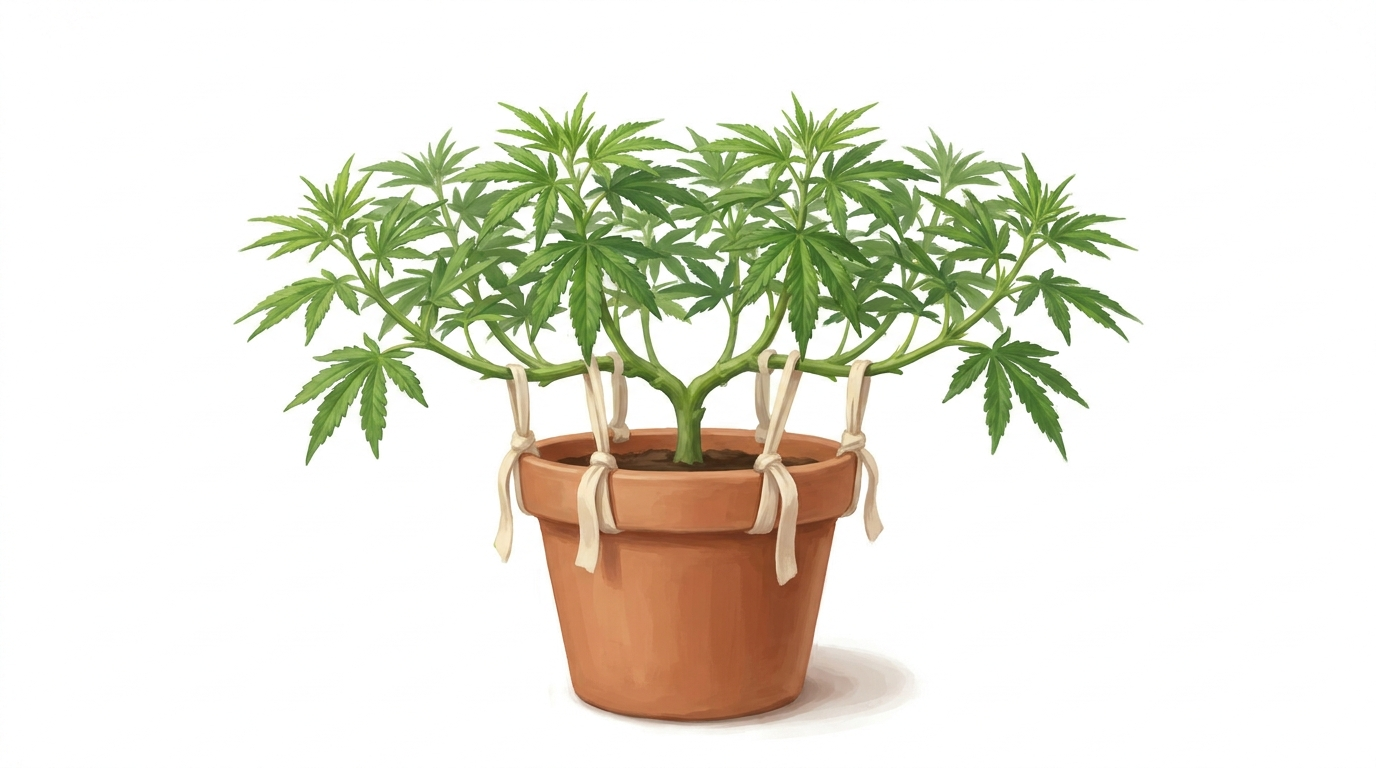
LST is the safest training there is, and the best first technique for a beginner: there’s nothing to cut, nothing to recover from, and you can’t really kill the plant with a bit of soft string. You’re just persuading her to grow wide and even instead of tall and lopsided. Done over a few minutes a day, it turns one dominant cola into a whole table of them.
The short version:
- LST = bending and tying stems flat, no cutting
- It beats apical dominance so lower branches catch up and become colas
- Start once the plant has 5–6 nodes, while stems are young and flexible
- Use soft ties anchored to the pot rim; aim for a flat “green table”
- It’s the only training that’s safe on autoflowers
Want the full breakdown? Keep scrolling.
How does LST work?
Same principle as topping, reached gently. The plant sends growth hormones to its highest tip (apical dominance), so left alone one cola hogs the light. Bend that tip down below the height of the other branches and the plant redistributes — the lower branches, suddenly the tallest, think they’re in charge and push upward, each becoming a potential main cola. Instead of a Christmas tree you get a flat table of even growth, every bud site the same distance from the light. More light on more sites means more bud, with no wound to heal.
How do I do it?
Start early, while stems bend instead of snap. Once the plant has five or six nodes, that’s your window — woody, thick stems crack. Use soft plant wire, pipe cleaners or fabric garden ties (DIG stock them); nothing sharp, and never something like chicken wire that cuts into the stem as she grows. Take the tallest stem, bend it gently to horizontal or near it, and tie it in place, anchored to the pot rim or hooks around the edge. Within a day or two the tip curves back up toward the light — that’s exactly what you want. The other branches are now level or taller, so they grow hard; tie those down as they rise. Keep repeating, keep the canopy flat. From above you’re aiming for a star — branches radiating out, all the same height, bud sites spread across the whole pot footprint.
What if a stem snaps — and does LST work on autos?
If you bend a stem too far and it partly tears — bark split but still connected — don’t panic. Wrap it snugly (not strangling) with micropore tape and leave it; within a week the plant heals the wound into a knot of scar tissue that’s actually stronger than before. A fully severed branch is gone, but the plant lives and the rest take its light — a tax, not a funeral. And the best part for beginners: LST is the one training that’s safe on autoflowers. Autos can’t recover from topping, but gentle bending early, stopping once the stretch begins, works fine. Pair LST with topping on a photoperiod and you’ve got the standard small-tent playbook for a flat, heavy canopy.
FAQ
When should I start LST? Around 5–6 nodes, while the stems are still young and flexible enough to bend without snapping. Earlier is easier than later.
What do I tie the branches with? Soft plant ties, pipe cleaners or fabric garden wire — anything that won’t cut into the stem. Anchor them to the pot rim or hooks around the edge.
Can I do LST on an autoflower? Yes — it’s the only training that’s safe on autos. Bend gently, start early, and stop once the plant begins its flowering stretch.
A branch cracked while I was bending it — is the plant ruined? No. If it’s still partly connected, tape it snugly and leave it; it heals stronger. Even a fully snapped branch only costs you that branch, not the plant.