What Size Pot for Cannabis? Container Guide
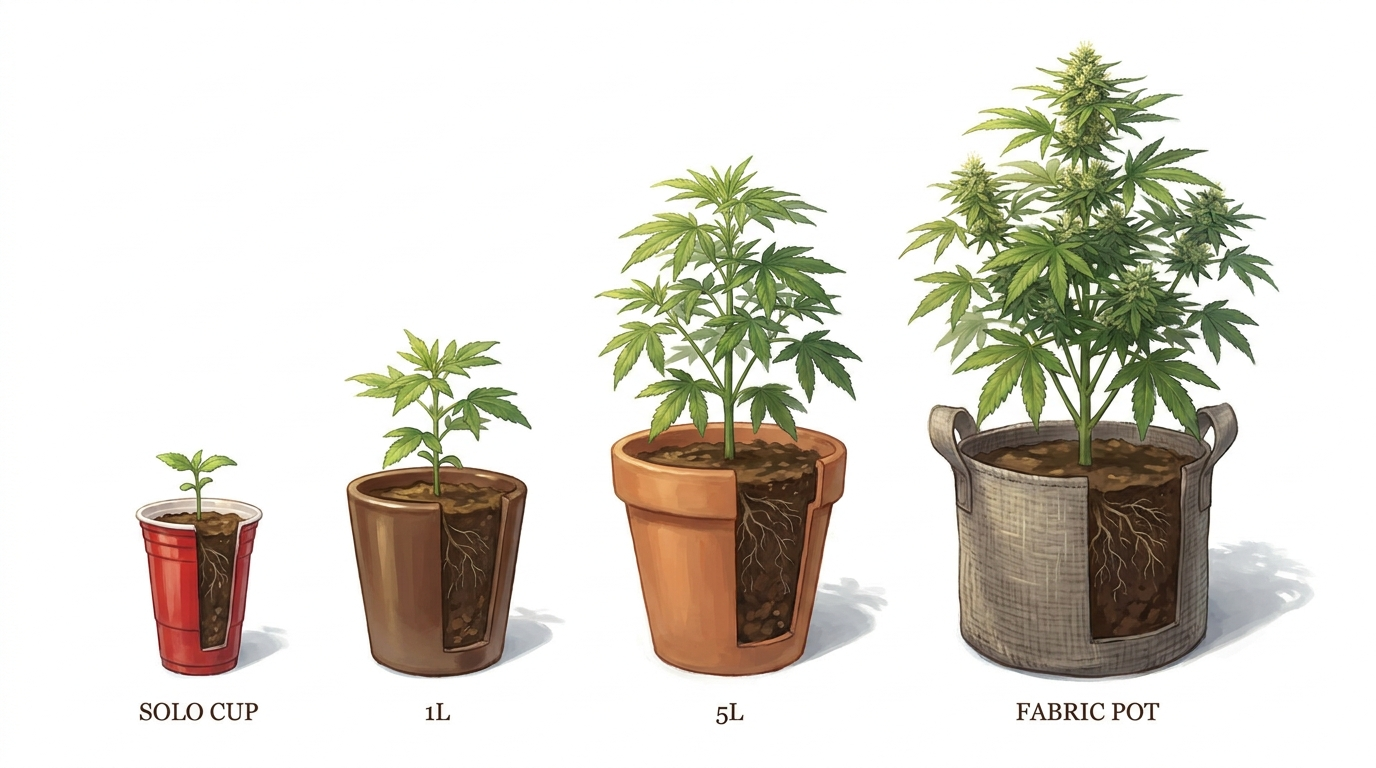
The pot matters almost as much as what’s in it. The wrong container gives you root-binding, swampy unused soil, or a plant that outgrew its home weeks ago. Here’s how to choose the material and, just as important, how to size up in stages.
The short version:
- Fabric pots are the default — they air-prune roots, drain well and forgive overwatering
- Plastic pots work if they have drainage holes, but roots circle and bind
- Pot up in stages: solo cup → 1–3L → final 11–25L
- Final size: ~11–15L for autos, 15–25L for photoperiods
- Don’t start a seedling in a huge pot — the unused soil stays wet and breeds problems
Want the full breakdown? Keep scrolling.
Fabric, plastic or air pots?
Fabric pots are the default recommendation, and for good reason: when a root hits the breathable wall, the air outside prunes the tip, so the plant branches new roots further back and builds a dense, fibrous root system instead of a spiralling mess. They drain better (water seeps through the fabric), the roots stay cooler, and they forgive the overwatering instinct because they dry back faster. The trade-off — faster drying means more frequent watering — is a feature, not a bug, since more wet/dry cycles mean more oxygen to the roots. Plastic pots work if they have drainage holes, but roots hit the smooth wall, turn, and circle into a choking spiral (root-binding) that builds invisibly until growth stalls. Air pots apply the same air-pruning idea in rigid plastic — effective, dry out even faster, but pricier and no better for a beginner than a fabric pot. For a first grow: a five-pack of 15L fabric pots costs less than a bag of soil and quietly prevents the drainage, root-binding and overwatering problems all at once. DIG stock them.
Why pot up in stages?
Because a small plant’s roots don’t explore a big pot — they sit in the middle, use what they can reach, and ignore the rest, which stays wet, cold and unused. The Mansion grower plants a seedling straight into a 25-litre pot to skip transplanting, and the vast surround of permanently damp soil breeds fungus gnats and goes anaerobic because no roots are drawing water through it. The seedling grows slower, not faster, because the soil-to-root ratio is so far off the medium never dries properly. So you step up: solo cup or 0.5L for germination to early seedling (a week or two), 1–3L for the young veg plant (two to four weeks), then the final pot. The signs she’s ready to move up are the same at every stage: roots poking out the drainage holes, the pot drinking dry in a day when it used to last three, and growth slowing despite good conditions. Don’t wait until she’s fully rootbound — that’s lost growth you can’t recover.
What size should the final pot be?
Roughly 11–15L for an autoflower in a 1.2m tent, and 15–25L for a photoperiod that vegs longer and grows bigger. The rule of thumb is about one to one-and-a-half gallons of soil per month the plant will spend in the container — so a three-month auto suits an 11L pot, a five-month photo a 20L. One note on autos: because their clock is fixed, some growers plant them straight into the final pot to avoid any transplant stress, watering in a small ring around the seedling and widening it as the roots spread. If you’re not confident managing water in a big pot with a tiny plant, the two-step approach (starter cup to final pot) is safer, and a gentle transplant causes minimal shock.
FAQ
What size pot do I need for a cannabis plant? About 11–15L for autoflowers and 15–25L for photoperiods as the final pot. Start smaller (solo cup, then 1–3L) and pot up as the roots fill each container.
Are fabric pots better than plastic? Generally yes — fabric pots air-prune roots for a denser root system, drain better and resist overwatering. Plastic works with drainage holes but lets roots circle and bind.
Can I plant a seedling straight into a big pot? It’s risky in soil — the unused soil stays wet and breeds gnats and rot, slowing the plant. Pot up in stages, or for autos use the watering-in-a-ring method if going straight to the final pot.