
Spider Mites: The Dot You Should Have Looked At
 Spider mites: pinprick stippling and, later, fine webbing on the undersides.
There was a single white dot on the underside of a fan leaf. I flicked it off with a thumbnail and called it dust. Nine days later there was fine webbing across the top of the canopy and things moving on it. The dot wasn’t dust. It was a scout, and I’d let the whole army in behind it. Specks and fine webbing under the leaves means spider mites, and they move fast, so don’t dawdle. That’s the whole rule. Everything below is just how to act on it before you lose a third of a grow like I did.
The short version:
- Pale stippling on the leaves from above; tiny specks and fine webbing on the undersides
- Spider mites — they breed in days and a single spray never finishes them
- Isolate her, wipe and spray the undersides, and treat every few days to catch the eggs
- Keep humidity up and airflow moving — they hate both
Want the full breakdown? Keep scrolling.
What do spider mites look like on cannabis?
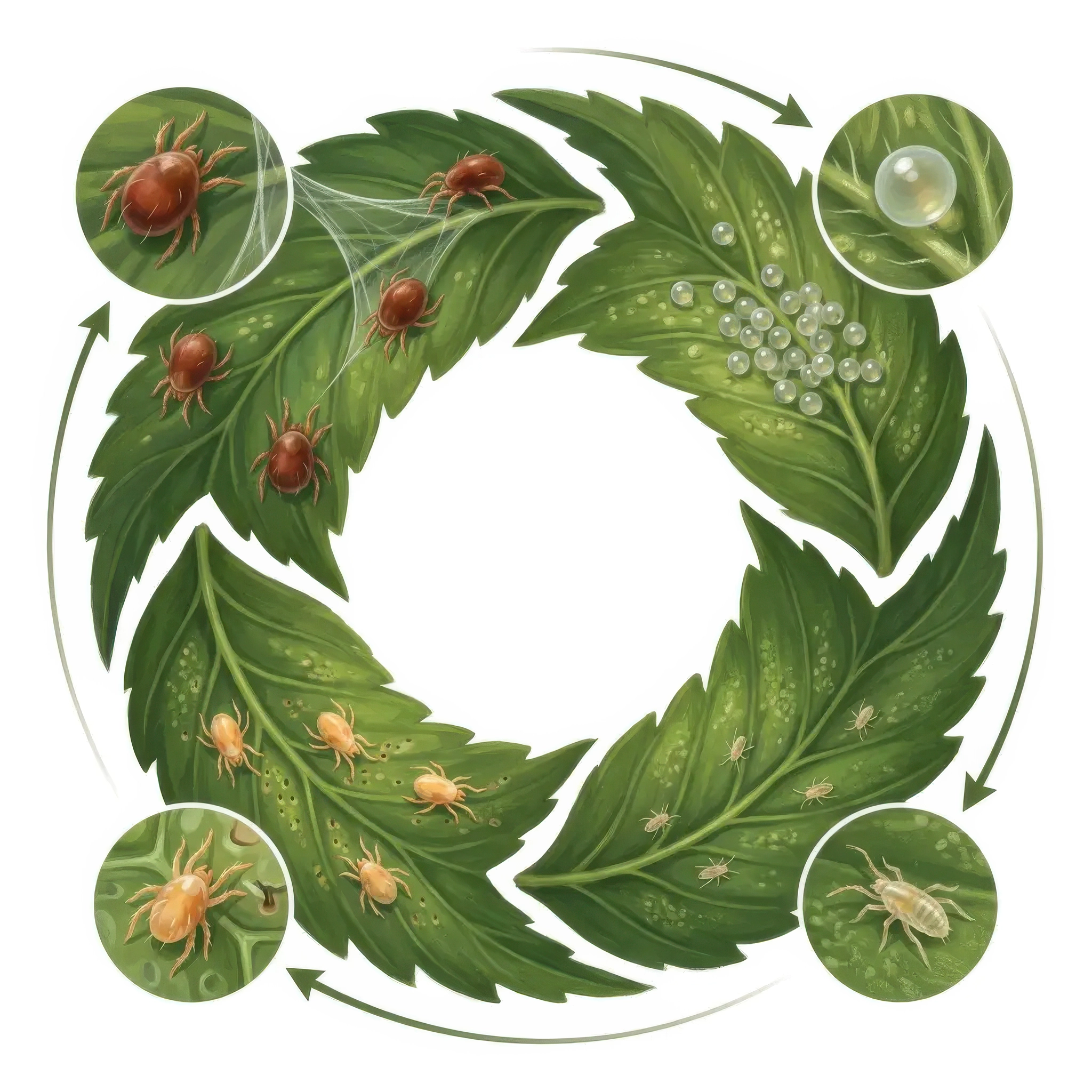 Why three sprays: you have to outlast the eggs the first pass misses.
From above, the first thing you notice isn’t the mite — it’s the damage. Tiny yellow or white speckles across the leaf, like the colour’s being lifted out in a fine dusty pattern. That’s stippling, where the mites have pierced the surface and sucked out the cell contents. Flip the leaf and look at the underside with a loupe (a tenner, fits in your pocket, single best pest tool you’ll own) and you’ll find them: barely-visible pale dots, clustered along the veins where the tissue is richest. They avoid light, so they live underneath, low and middle canopy first.
The webbing is the late sign, not the early one. By the time you can see fine threads strung between leaves, the colony is big enough to be building structures to travel on, and you’re no longer preventing — you’re managing a crisis. Don’t mistake mite stippling for a nutrient issue: deficiencies follow a pattern up or down the plant, while mite damage is a fine, even speckle with the culprits living on the back of the leaf. When in doubt, get the loupe out.
Where do spider mites come from and why do they spread so fast?
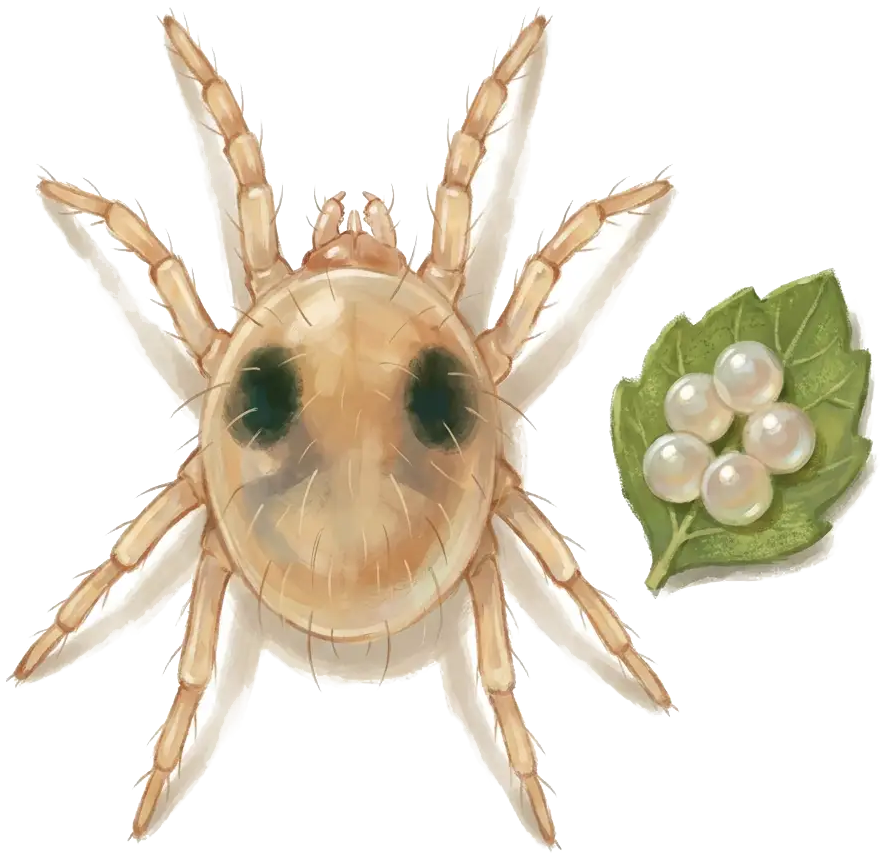 The culprit, magnified: two-spotted mite, eggs alongside. You’ll rarely see it without a loupe.
Two answers: they hitch in, and your tent invites them to stay. Most infestations arrive on a new plant — a free clone from a mate, a cutting, second-hand gear — carrying eggs you can’t see. That’s why every new plant earns a week in isolation, inspected daily with the loupe, before it goes near the main tent. Free genetics aren’t free if they bring passengers.
Once they’re in, the environment decides how fast it goes wrong. Mites love warm, dry, still air — above 25°C, humidity under 40%, poor circulation. That’s a holiday resort for them. The reason a single dot becomes a webbed disaster in nine days is the maths: a female lays hundreds of eggs, and those eggs hatch in three to five days in the warm. The population doesn’t creep, it compounds. By the time you notice the adults, the next generation is already in the eggs, waiting.
How do I get rid of spider mites?
You’re not killing a few bugs. You’re breaking a lifecycle, and that changes the whole approach.
- Isolate her first. Mites walk and ride between plants. Move the affected plant away from the rest before you do anything else.
- Treat the undersides. Wipe and spray where they actually live — the backs of the leaves, low and middle. The top of the canopy is the last place they are, not the first.
- Treat three times, five to seven days apart. This is the bit The Optimist gets wrong, spraying once and declaring victory. Most sprays kill adults and nymphs but not eggs. First treatment clears the living mites. Second, five days later, catches the eggs that have since hatched. Third catches the stragglers. One spray is a gesture, not a treatment. Mark the dates down.
- Choose the spray by stage. Insecticidal soap or a proper IPM spray breaks down fast and leaves little residue — DIG stock the sensible options. No spraying in the last two to three weeks before harvest; you’re going to smoke this. If it’s that bad that late, the answer is an early harvest, not a late spray.
- Bring in predators for the long game. Predatory mites eat spider mites and keep eating without residue or timing — order a sachet, hang it in the tent, let them work. DIG stock them.
Then keep them out: get the airflow moving with an oscillating fan, nudge humidity up out of their comfort zone (they struggle above about 55%, which is where your veg plant is happy anyway), keep the space clean, and quarantine everything new. The environment does more prevention work than any spray on the shelf.
FAQ
How do I know if it’s spider mites or a nutrient deficiency? Mites leave a fine, even speckle across the leaf and live on the underside — flip a leaf and look with a loupe. Deficiencies follow a clear pattern, fading from the bottom up or the top down, with nothing living on the back of the leaf. If the damage is dusty and patchy and there are specks underneath, it’s mites.
Why do my spider mites keep coming back after I spray? Because one spray only kills the adults, not the eggs. The eggs hatch a few days later and the cycle restarts. You need three treatments spaced five to seven days apart to catch each hatch, or you’re just trimming the population, not ending it.
Can I save a plant covered in spider mite webbing? Heavy webbing means a large, established colony, but it’s not automatically over. Isolate her, treat the undersides hard on the three-spray schedule, and lift the humidity. If she’s within two to three weeks of harvest and the buds are still mostly clean, an early chop often beats a long, losing fight.
Do predatory mites actually work? Yes, and they’re how clean commercial grows stay clean. You introduce a specific predator that hunts spider mites and nothing else, and they work continuously without residue or spray timing. They work best as prevention and on light-to-moderate infestations, alongside good airflow and humidity, not as a last-minute rescue on a webbed-up plant.
Not sure this is your problem? Run her through the Diagnosis Buddy — five questions and you’ll know.
Fixed it?
Here’s how this stage goes when it’s going right — walk the grow →. Still not sure what you’re looking at? Ask the Diagnosis Buddy →